WHY VINTAGE WEDDING DRESSES DON’T FIT PROPERLY – (AND WHATS REALLY HAPPENING)
.
The Dress That “Fits” – But Doesn’t Hold
Perhaps you’ve discovered or inherited a vintage gown. It’s the right size. It closes and looks fine.
But still, there are contradictions. The gown doesn’t hold – which is often why vintage wedding dresses don’t fit properly – even when they appear to.
You may notice the following are off:
The neckline not quite right.
The bodice sags.
The lower half sits out of balance.
What appears to fit is often only resting on the body – not supported by it.
This is where vintage garments begin to fail.
.
.
.
What Time Changes – Even When the Dress Looks Intact
.
Vintage dresses carry more than history. They carry structural change.
Over time:
Interlinings harden
Crinoline loses flexibility
Seam allowances weaken
Internal support (if it existed) softens or disintegrates
From the outside, none of this is visible. But during a fitting, it becomes immediately clear in the behaviour and movement.
It doesn’t respond. It resists. Or it collapses.
.
The Hidden Construction No One Sees
.
When approaching a vintage wedding dress reconstruction, the real story sits beneath the surface.
We often find:
Skirts mounted onto aged, rigid crinoline
Hemlines built with wadding for volume
Bodices with no internal structure
Piping or seams too fragile to rework
.
These are not faults. They are markers of how the dress was originally made using materials available at the time it was made – and now, those materials have perished.
This work is complex bridal alterations requiring examination to determine the best path forward.
.
Why Standard Alterations Fall Short on Vintage Gowns
.
Modern day alterations work is often surface level:
taking in or letting out seams, shortening hems, adjusting straps.
That approach may fix some issues initially – until it doesn’t.
When the issue is structural:
Taking in the bodice does not create support – it creates dragging and misalignment
Shortening the skirt does not correct proportion
Tightening a neckline does not stop it from slipping
At this point, (if these are the issues faced) the dress is no longer being altered.
It is being rebuilt.
.
What Structural Reconstruction Actually Means
.
Reconstruction is not adjustment. It is intervention.
It often involves:
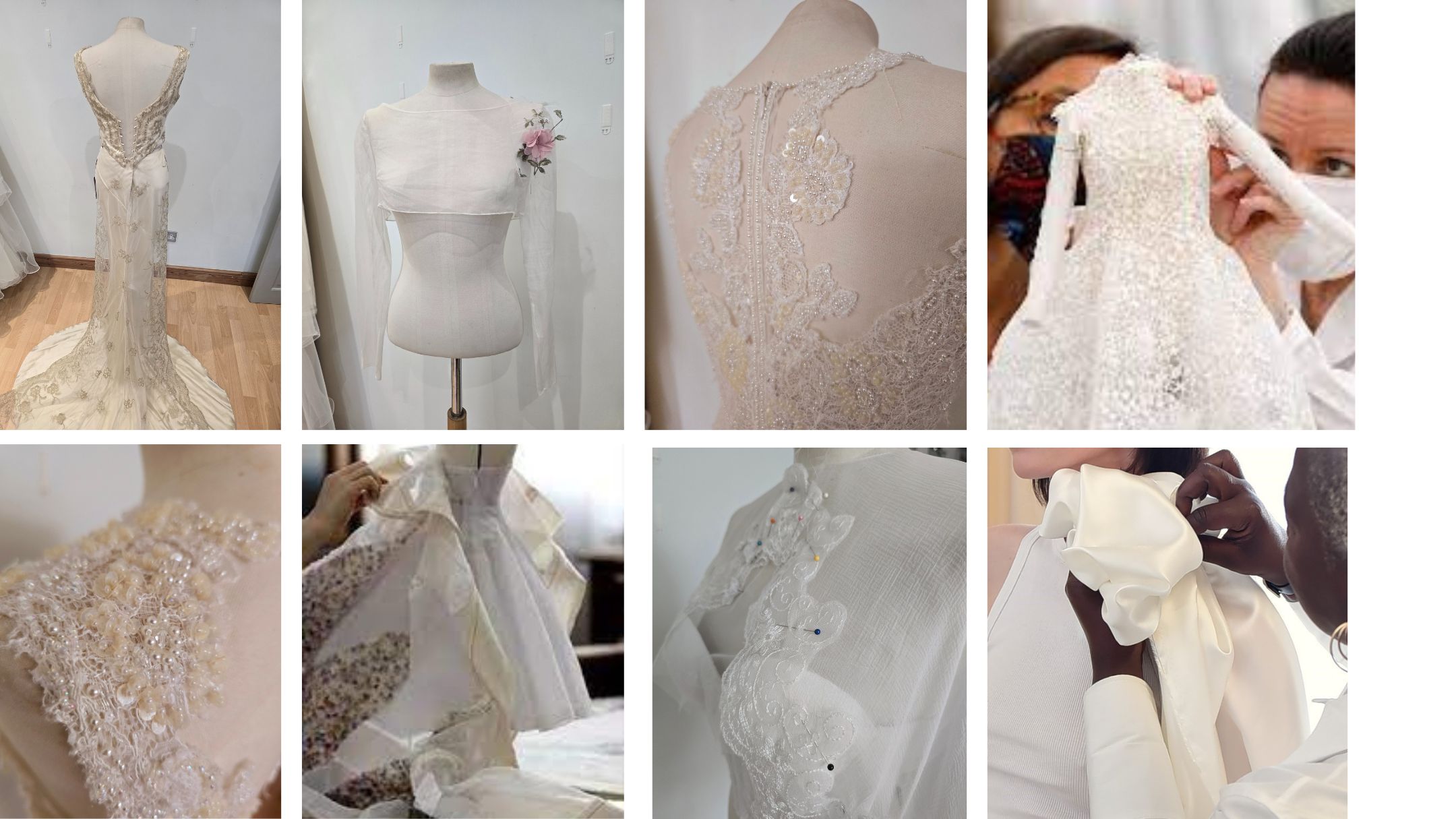
Recutting the bodice to change proportion
Introducing internal architecture (lining, boning, support channels)
Redistributing weight across the garment
Working with original construction rather than against it
The goal is not to modernise the dress.
It is to allow it to function again – properly, securely, and in balance with the body wearing it.
.
Fabric Behaviour: The Deciding Factor
.
Vintage fabric does not behave like new fabric.
It can:
Mark under pressure
Resist pressing
React unpredictably to heat and steam
In some cases, even removing a seam can cause damage.
This is why decisions are made slowly, often tested first, and never forced.
Patience replaces assumption.
.
When Reconstruction Becomes the Only Option
.
There is a point where simple alteration is no longer viable.
You’ll recognise it when:
The bodice cannot support the bust
The dress requires constant adjustments during movement
The proportions feel visually and physically unbalanced
At this stage, the question is no longer
“Can this be altered?”
It becomes:
“Can this be rebuilt without losing what it is?”
.
.
A Real Example of What Lies Beneath
.
In one recent project, a vintage silk gown appeared relatively straightforward from photographs.
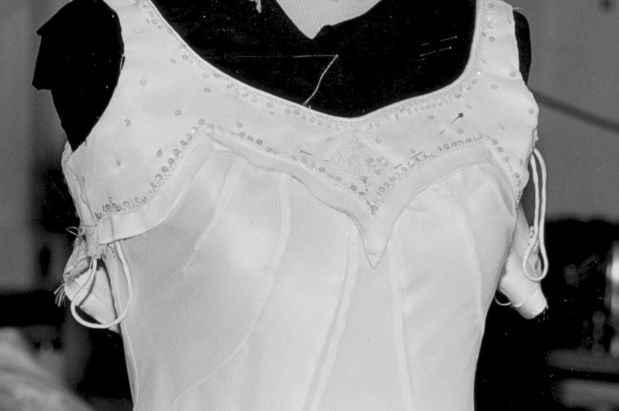
Only in the studio did the internal reality emerge:
hardened crinoline supporting the entire skirt
a bodice with no internal structure
seam allowances too limited to reuse
a neckline that could not be adjusted without recutting
.
The solution required a full internal rebuild while preserving the original silhouette.
You can see how that process unfolded here:
Vintage wedding dress reconstruction case study
.
.
Final Thought
.
Vintage gowns are not fragile, unworkable garments but they are specific.
They require:
understanding of how they were made
respect for how they have aged
and the ability to rebuild without erasing their identity
.
This is why vintage wedding dresses don’t fit properly – not because of size, but because of underlying structure.
.
.
FAQ
.
Why does my vintage wedding dress look as though it is sagging in places even though the size is correct?
Because fit and structure are not the same. Many vintage gowns lack internal support, so they sit on the body rather than holding it in place.
.
Can a vintage dress be altered like a modern gown?
Not always. Vintage construction, aged fabrics, and limited seam allowances often require reconstruction rather than standard alteration.
.
What causes structural failure in older gowns?
Hardened crinoline, weakened interlinings, absence of boning, and fabric ageing all affect how the dress holds and moves.
.
Will reconstruction change the original design?
No. The aim is to preserve the visual identity while rebuilding the internal structure so the dress functions properly.
.
Is vintage fabric at risk during alterations?
Yes. Older fabrics can mark, weaken, or react unpredictably. Work must be approached carefully and tested before any intervention.
.
How do I know if my dress needs reconstruction?
If the bodice doesn’t support you, the neckline shifts, or the dress feels unstable when you move, it likely requires structural work.
.
Why Brides Choose OM Bridal
.
Over 40 years of couture expertise
Trusted by brides requiring discretion and high-level craftsmanship
Honest technical advice — including when a change should not be made
A calm, considered atelier environment in London
.
Our approach is shaped by our extensive experience with luxury bridal and eveningwear, with work developed alongside houses including Suzanne Neville, Castigliano, Emilia Wickstead, Temperley London, Pronovias, Vivienne Westwood, Roland Mouret, Victoria Beckham, and Valentino
Considering Heirloom Wedding Dress Remodelling?
.
If you are entrusted with a vintage wedding gown, the first step is assessment – not assumption.
You deserve clarity about what is possible.
Private consultations are available for brides who wish to explore heirloom wedding dress remodelling with care and discretion.
.
BOOK A CONSULTATION
.
.
OM Bridal | Location
.
The OM Bridal Studio is a 7 mins walk from North Acton Station – 19 mins from Bond Street via Central line.
Please note – During the summer months customer orders can take up to 6 weeks to complete so early booking is advised.
.